Every spring, Pennsylvania homeowners walk their property lines only to find the same frustrating sight: vinyl siding that buckled during a January deep freeze or cedar planks that woodpeckers have turned into swiss cheese. You want a home that stands out in the neighborhood without requiring a second job’s worth of maintenance. Understanding the fiber cement siding pros and cons PA residents face is the first step toward a permanent solution for your home’s exterior.
We know that choosing a siding material is a high-stakes decision for your biggest investment. It’s about more than just curb appeal; it’s about structural integrity and peace of mind. In this guide, you’ll discover how fiber cement stacks up against our state’s volatile weather and why it’s often the smartest way to boost your home’s resale value. We’ll preview the latest 2026 design trends, explain how the James Hardie HZ5 series is engineered specifically for our climate, and walk through the impact of the 2021 International Building Code updates that took effect in PA this year. You’ll gain a clear picture of whether this durable material is the right fit for your property and your budget.
Key Takeaways
- Learn why fiber cement offers superior protection against Pennsylvania’s harsh freeze-thaw cycles and heavy snow loads compared to vinyl.
- Weighing the fiber cement siding pros and cons PA homeowners face reveals that the higher initial investment is offset by a lifespan of 50 or more years.
- Discover the peace of mind that comes with a Class A fire rating and complete resistance to woodpecker damage and rot.
- Understand the critical role of professional installation in managing moisture and protecting your property’s structural integrity.
- See how upgrading your siding can significantly boost your home’s resale value and integrate with other exterior projects like custom decks or sunrooms.
What is Fiber Cement Siding and Why is it Trending in PA?
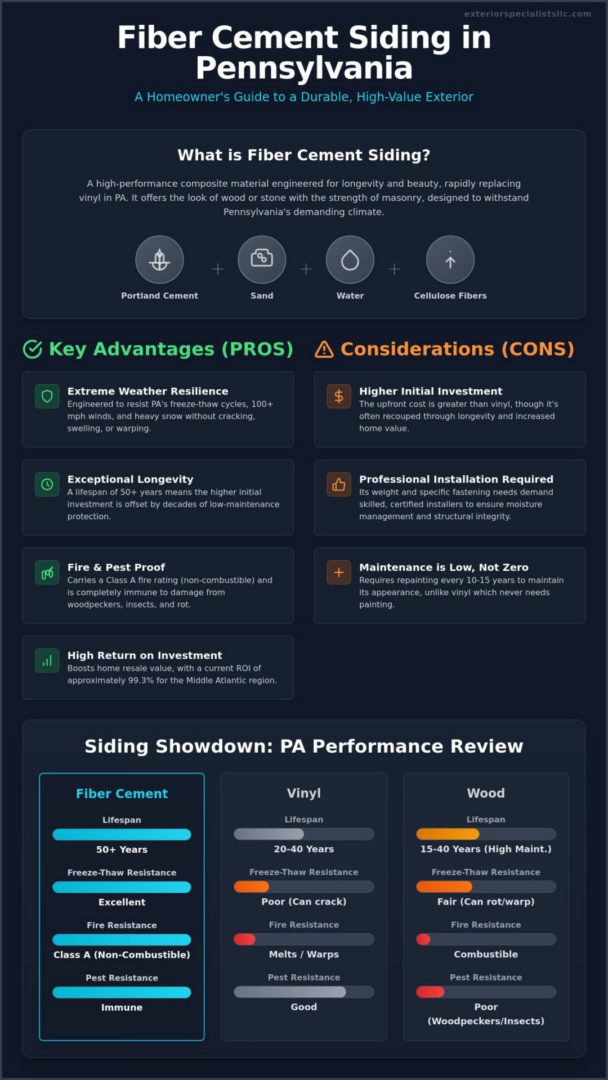
Understanding What is Fiber Cement Siding? begins with its unique recipe. It’s a high-performance composite of Portland cement, sand, water, and cellulose fibers. We’ve watched a massive shift in 2026 as Southeastern PA homeowners move away from vinyl in record numbers. People are tired of brittle panels and warped edges. They want a material that feels substantial and looks like it belongs on a permanent structure. As we evaluate the fiber cement siding pros and cons PA residents deal with, it’s clear that this material bridges the gap between the beauty of wood and the strength of masonry.
This siding doesn’t just look tough; it’s engineered for our specific climate. The James Hardie HZ5 series is the regional standard here because it’s designed to survive the brutal freeze-thaw cycles that characterize our winters. Whether you want the look of historic Main Line stone or the classic texture of cedar shakes, this material offers aesthetic versatility without the rot or woodpecker problems common in our wooded suburbs.
The Composition of Durability
The secret to this material’s longevity lies in the precise cement-to-fiber ratio. This mixture prevents rot and fungal growth even during our most humid July stretches. During the manufacturing process, the boards are cured to ensure dimensional stability. This means they won’t expand or contract nearly as much as vinyl or wood when the temperature swings forty degrees in a single day. It’s significantly heavier than other options. This weight requires a professional touch for installation, but it provides a protective barrier that feels as solid as the foundation of your home.
Fiber Cement in the Southeastern PA Landscape
Aesthetics matter deeply in communities like Newtown Square, Radnor, and West Chester. Many local townships have strict requirements for maintaining a historic look. Fiber cement is the perfect solution because it mimics natural wood grain so closely that it’s often indistinguishable from the sidewalk. It fits the architectural soul of our region while providing modern protection.
The impact on property values in 2026 is undeniable. In the Middle Atlantic region, fiber cement siding replacement currently sees a return on investment of approximately 99.3 percent. With Pennsylvania adopting the 2021 International Building Code this year, choosing high-performance materials like fiber cement helps ensure your home meets the latest standards for safety and structural integrity. It’s a smart play for anyone looking to secure their investment for the next fifty years.
The Major Pros: Why Fiber Cement Wins in the PA Climate
Pennsylvania weather isn’t just a topic for small talk; it’s a relentless test for your home’s exterior. From the heavy snow loads in the northern counties to the intense humidity of a Philadelphia summer, local houses face a unique set of environmental stressors. When you weigh the fiber cement siding pros and cons PA residents encounter, the list of advantages starts with sheer physical resilience. This material doesn’t just sit on your house; it protects it like a suit of armor.
Resilience Against Pennsylvania Weather
Our region is famous for its “freeze-thaw” cycles. This happens when moisture gets trapped behind siding, freezes, and expands, causing vinyl to crack or wood to rot. Fiber cement is engineered to handle these shifts without flinching. It maintains its dimensional stability, meaning it won’t swell during a muggy Delaware County July or shrink when the thermometer drops below zero. During seasonal Nor’easters, your home needs to withstand 100+ mph winds. Because fiber cement is heavy and requires professional installation, it stays anchored to your wall studs far better than lightweight alternatives.
Safety is another non-negotiable factor. Fiber cement is non-combustible and carries a Class A fire rating. This means it won’t melt like vinyl or ignite like wood when exposed to direct flame. It’s a layer of protection that provides genuine peace of mind for families living in wooded suburbs or high-density neighborhoods alike.
The ‘Woodpecker-Proof’ Advantage
If you’ve ever owned a home with cedar or EIFS siding in the PA suburbs, you know the sound of a woodpecker drilling into your investment. It’s the number one complaint we hear from local homeowners. These birds are looking for insects or trying to drum for a mate, and they can destroy a wood exterior in a single afternoon. Fiber cement is simply too hard for them. It offers a physical deterrent that wildlife ignores, saving you thousands in long-term pest control and exterior patching. Termites also find zero nutritional value in a cement-based board, which is a major win for properties near our lush, wooded parks.
Finally, let’s talk about color. Many factory-applied finishes now use UV-resistant technology. This ensures your home looks as vibrant in ten years as it did on day one, even after enduring our humid, sun-drenched summers. If you’re ready to see how these benefits apply to your specific property, you can explore our siding solutions to find the perfect match for your home’s style.
The Cons and Considerations: Balancing the Investment
Every major home improvement project involves trade-offs. While the benefits of this material are substantial, we believe in providing a complete picture so you can make an informed choice for your property. Weighing the fiber cement siding pros and cons PA homeowners encounter means looking closely at the initial budget and the technical requirements of the material. It’s not the cheapest option on the market, but it’s often the most valuable one over time when you consider the full life cycle of your home.
The Cost-Value Equation in 2026
In the Philadelphia suburbs, the initial price for fiber cement is higher than vinyl. This is the most common hurdle for homeowners. However, the return on investment in the Middle Atlantic region is approximately 99.3 percent. When you consider that fiber cement siding has a documented lifespan of 50 or more years, while vinyl typically needs replacement every 20 to 25 years, the math starts to favor the more durable option. You aren’t just buying boards; you’re buying decades of avoided replacement costs and peace of mind.
There’s also the insurance factor to consider. Because fiber cement is non-combustible and carries a Class A fire rating, some Pennsylvania insurance providers may offer more favorable terms or lower premiums. It’s worth a call to your local agent to see how this upgrade affects your specific policy. Protecting your investment from the start can lead to consistent savings year after year.
Installation and Weight Factors
This material is heavy. It requires a sturdy structural frame and specialized handling that makes it a poor choice for a DIY weekend project. Installing fiber cement requires specific tools, such as shears or saws with dust-collection systems and diamond-tipped blades. Improper cutting or fastening doesn’t just look bad; it can actually void the manufacturer’s warranty and lead to structural issues down the road.
We prioritize the integrity of the moisture barrier behind the siding. Because these panels are so substantial, the house wrap and flashing must be installed with precision to prevent water from becoming trapped. Our team focuses on these technical details to ensure your home remains dry and sound. A professional installation ensures the siding integrates perfectly with your existing windows and trim, creating a seamless protective envelope.
The Reality of Maintenance
It’s a mistake to call any exterior material “maintenance-free.” Fiber cement is low-maintenance, but it still requires some attention to stay in top shape. You’ll need to wash it down once or twice a year with a garden hose to remove dirt and pollen. If you choose a factory-applied finish like ColorPlus® technology, the color is designed to resist fading for 15 or more years. Eventually, you may need to repaint, but the intervals are much longer than those for traditional wood siding. This predictable maintenance schedule is part of what makes fiber cement a reliable choice for busy families.
Fiber Cement vs. Vinyl and Wood: A Regional Performance Review
Choosing the right exterior material often comes down to a three-way race between vinyl, natural wood, and fiber cement. In our local neighborhoods, this isn’t just about price. It’s about how the material behaves ten years after the crew leaves your driveway. When analyzing the fiber cement siding pros and cons PA homeowners consider, the regional performance differences become very clear. Each material reacts differently to our specific humidity levels and temperature swings.
The Battle of the Suburbs: Vinyl vs. Fiber Cement
Vinyl is a common choice due to its low initial cost, but it has physical limitations in our climate. If you live in the windy Delaware County hills, you’ve likely heard the distinctive rattle of vinyl panels during a storm. This happens because vinyl must be hung loosely to allow for thermal expansion. Fiber cement is nailed tight to the studs, providing a quiet, rock-solid feel. It also wins on impact resistance. While a stray baseball or a heavy hailstone can easily crack brittle vinyl, fiber cement handles these strikes without a mark. From an environmental standpoint, fiber cement is more sustainable. It’s made from abundant natural materials, whereas vinyl is a petroleum-based product that’s difficult to recycle.
Preserving the Main Line Aesthetic: Wood vs. Fiber Cement
For many homes in historic districts or along the Main Line, the goal is to maintain a traditional look. Natural cedar is beautiful, but it requires a grueling maintenance cycle. You’ll often find yourself scraping and painting every five to seven years to prevent rot. Fiber cement allows you to achieve that deep cedar grain texture without the constant upkeep. It’s the preferred choice for home additions in historic areas because it respects the original architecture while providing modern rot resistance. If you’re planning a project in the area, our Siding Contractor Chester County PA guide offers more details on matching local styles.
Performance in the winter is where the differences really show up on your utility bill. While siding itself isn’t a primary insulator, the way it fits together affects your home’s thermal envelope. Fiber cement’s dimensional stability prevents the gaps that often form in wood or vinyl as they age. This helps maintain your home’s R-value and keeps drafts at bay during a February cold snap. In terms of visual longevity, fiber cement holds its new look far longer than the competition. It doesn’t chalk like vinyl or peel like wood. It simply stays crisp and clean. If you’re ready to upgrade your home’s protection, you can get a professional siding assessment to see which option fits your property best.
Maximizing Your Investment with Professional Installation in PA
Even the highest-quality boards will fail if they aren’t installed with precision. When you evaluate fiber cement siding pros and cons PA homeowners must prioritize the skill of the crew as much as the material itself. A poor installation leads to moisture traps and voided warranties, while a professional job ensures your home remains a fortress for the next fifty years. At Exterior Specialist LLC, we believe that craftsmanship is the foundation of structural soundness.
Why Local PA Knowledge Matters
The Brandywine Valley has specific humidity challenges that can affect how a home breathes behind its exterior skin. We ensure that every joint and seam is handled according to strict regional standards. This includes meticulous flashing around existing structures like your custom decks or patios. Water management is our top priority because trapped moisture is the primary enemy of any home’s frame. If you’re currently vetting local teams, our guide on Choosing the Best Remodeling Contractor on the Main Line PA provides essential tips for finding a partner who understands our local architecture.
Compliance is a moving target in our state. As of January 1, 2026, Pennsylvania has officially adopted the 2021 International Building Code (IBC). This update changes the requirements for structural components and protective barriers. There is a six-month concurrency period for contracts signed before the new year, but all permit applications submitted after July 1, 2026, must fully comply with the 2021 standards. We stay ahead of these regulatory shifts so your project is safe, legal, and built to last.
The Holistic Guardian Approach
We don’t view your home as a series of isolated parts. We act as a holistic guardian of your property’s entire outer structure. Whether we’re integrating new siding with your existing sunrooms or coordinating a full window replacement to maximize energy efficiency, our goal is a seamless protective envelope. During the replacement process, we take active steps to protect your landscaping and hardscapes from construction debris. We understand that a siding project can feel chaotic, so we maintain an orderly job site to minimize the stress on your family.
Our commitment to transparent business practices means you’ll always know exactly where your project stands. We start every relationship with a no-obligation assessment to help you determine if fiber cement is the right fit for your budget and your home’s specific needs. By combining industry-specific terminology with a neighborly sense of accountability, we provide the peace of mind you deserve. If you’re ready to secure your property’s future with a durable, high-performance exterior, we’re here to lead the way.
Secure Your Home’s Future with a Permanent Exterior Solution
Investing in your home’s exterior is one of the most significant decisions you’ll make as a property owner. After weighing the fiber cement siding pros and cons PA residents must consider, the choice often comes down to long-term value versus short-term savings. With a regional return on investment of approximately 99.3 percent and a lifespan that can exceed fifty years, fiber cement stands as a superior guard against our local climate. It offers the aesthetic charm of traditional wood without the constant maintenance or the risk of woodpecker damage.
We’ve been serving Southeastern PA since 1990, providing comprehensive exterior solutions across Delaware, Chester, and Montgomery Counties. Whether you’re looking for a complete siding overhaul or want to integrate your new exterior with custom decks and sunrooms, our team brings a neighborly sense of accountability to every project. We handle the technical details of the 2021 building codes so you don’t have to worry about compliance or structural integrity.
Schedule your no-obligation siding assessment with Newtown Square’s trusted experts today. We’re ready to help you transform your home into a beautiful, durable sanctuary that stays protected for decades to come.
Frequently Asked Questions
Is fiber cement siding better than vinyl for Pennsylvania weather?
Fiber cement offers superior durability for our local climate because it doesn’t expand and contract like vinyl. This stability prevents the warping and cracking often seen after a harsh winter in the Philadelphia area. It also withstands the high winds of seasonal storms much more effectively than lightweight plastic alternatives.
How much more does fiber cement siding cost compared to vinyl in PA?
While the initial investment for fiber cement is higher than vinyl, the long-term cost is lower due to its durability. You’ll avoid the replacement cycle that vinyl requires every two decades. When researching fiber cement siding pros and cons PA homeowners often find that the increased property value and longevity make it the more economical choice over the life of the home.
Does fiber cement siding really protect against woodpeckers in Chester County?
Woodpeckers find it impossible to penetrate the dense composite material. Unlike cedar or EIFS, fiber cement doesn’t sound hollow and provides no incentive for birds to drum or look for insects. It’s a permanent solution for homeowners in wooded areas like West Chester or Radnor who are tired of patching holes every spring.
How often do I need to repaint fiber cement siding in the Northeast?
If you choose a factory-applied finish, you typically won’t need to repaint for 15 or more years. The specific climate in the Northeast, with its high humidity and temperature swings, can be tough on paint; however, the dimensional stability of the boards prevents the peeling and flaking that occurs on natural wood.
Is fiber cement siding waterproof and mold-resistant?
It is highly resistant to moisture and does not support the growth of mold or mildew. The material is designed to stay sound even during the muggy summers of the Brandywine Valley. Proper installation ensures that water is diverted away from your home’s structural frame, preventing internal rot.
Can fiber cement siding be installed over existing wood siding?
We strongly recommend removing old wood siding before installation. Stripping the exterior down to the sheathing allows us to inspect for existing rot and install a modern, high-performance moisture barrier. This ensures the new siding sits flat and remains structurally sound for decades.
Does installing fiber cement siding increase home value in the Philadelphia suburbs?
Yes, it significantly boosts resale value and curb appeal. Buyers in the Philadelphia suburbs recognize fiber cement as a premium, low-maintenance material. It provides an immediate return on investment by making the property more attractive and reducing the future maintenance burden for new owners.
What is the average lifespan of fiber cement siding in the Mid-Atlantic region?
You can expect a lifespan of 50 or more years when the material is professionally installed and maintained. This longevity far exceeds that of vinyl or natural wood. It’s a one-time investment that protects your property’s structural integrity for as long as you own the home.
