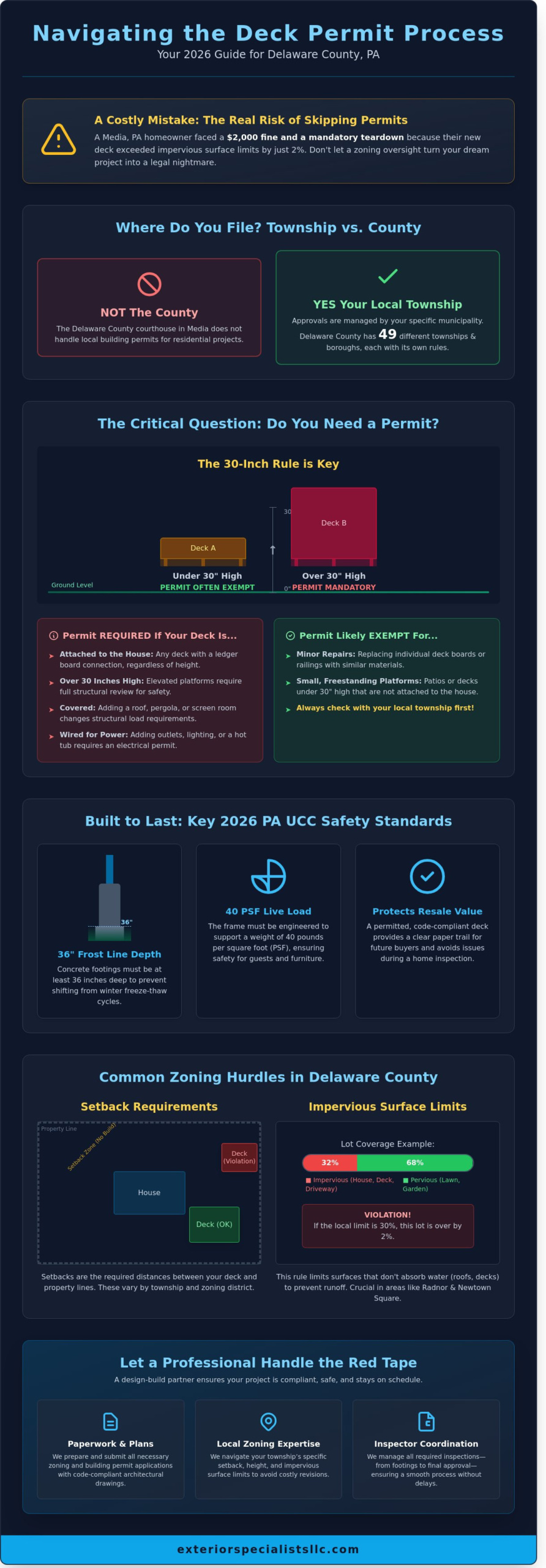
Last April, a homeowner in Media faced a $2,000 fine and a mandatory teardown because their new platform deck exceeded impervious surface limits by just 2 percent. It is a stressful scenario that occurs frequently when the deck permit process Delaware County homeowners must navigate is treated as an afterthought. You are looking to build a lasting investment for your family, but one simple zoning mistake can turn your dream renovation into a costly legal headache.
We know that managing the paperwork for any of the 49 municipalities in Delco feels overwhelming. It is natural to feel anxious about setbacks or the technical specifics of the PA Uniform Construction Code (UCC). Our guide simplifies these complexities by providing a direct roadmap for 2026 local regulations. You will find a complete checklist of required documents for your township office and a clear timeline for approvals. We are here to ensure your project is fully code-compliant so you can focus on enjoying your new outdoor space without the fear of a surprise inspection.
Key Takeaways
- Learn why your local township, rather than the county, manages building approvals and how PA safety codes protect your home’s long-term value.
- Understand the “30-inch rule” and other specific triggers that define the deck permit process Delaware County municipalities require for new construction.
- Identify the essential paperwork, from property surveys to framing details, needed to move your application efficiently through the zoning office.
- Navigate tricky local zoning challenges, including setback requirements and the impervious surface limits common in areas like Radnor and Newtown Square.
- Discover how a professional design-build partner manages the technical red tape and inspector relationships to ensure your project stays on schedule.
Understanding the Delaware County Deck Permit Structure
Starting a project in Delco often begins with a trip to the local office, but it’s not the one you might expect. While the county seat is in Media, the actual deck permit process Delaware County homeowners must follow is managed strictly at the municipal level. This means your local township or borough handles the applications, inspections, and final approvals rather than a centralized county department. These local officials enforce building code standards to ensure every new structure protects the family using it. At Exterior Specialists LLC, we’ve seen how skipping this step leads to structural failures or legal headaches during a home sale. A permit is your professional proof that the deck’s foundation, framing, and attachments meet rigorous safety benchmarks.
Municipal vs. County Jurisdiction in Delco
You won’t find building inspectors for your backyard project at the county courthouse. Instead, you’ll need to visit your specific township building to submit your plans. Whether you live in Newtown Square, Radnor, Marple, or Upper Darby, each municipality has its own unique set of zoning laws and application fees. Before drawing up plans, visit your township’s official website to locate your specific zoning map. This map determines your “setbacks,” which is the required distance between your deck and the property line. As a local, licensed, and insured contractor, we help neighbors navigate these specific local requirements to ensure the project starts on solid ground.
The 2026 PA UCC Standards for Decks
Pennsylvania operates under the Uniform Construction Code (UCC), which sets the baseline for safety across the state. In 2026, these standards remain focused on preventing the most common deck failures seen in older builds. Inspectors look closely at railing heights, stair geometry, and the installation of ledger board flashing to prevent wood rot against your house. One of the most critical requirements in Southeastern Pennsylvania is the 36-inch frost line depth for footings. If your footings are shallower than 36 inches, the winter freeze-thaw cycle will heave the posts and destabilize the entire frame. Many “grandfathered” decks built before these strict codes often fail modern inspections when a homeowner tries to sell their property. Investing in a code-compliant deck now protects your home’s resale value and your family’s safety.
- Structural Integrity: Ensures the frame can handle weight loads of 40 pounds per square foot.
- Frost Line Protection: Prevents shifting by requiring 36-inch deep concrete footings.
- Resale Value: Provides a clear paper trail for future buyers and home inspectors.
When Do You Need a Deck Permit in PA?
Determining whether your project requires official approval is the first step in the deck permit process Delaware County homeowners must navigate. In Pennsylvania, these rules are not arbitrary. They are governed by the Pennsylvania Uniform Construction Code (UCC), which sets the safety baseline for every township from Upper Darby to Concord. Most projects involve a two-step approval. First, you will need a zoning permit to ensure your deck does not cross property lines or violate setback requirements. Second, a building permit confirms the structure can safely support the weight of your family and guests.
The 30-inch rule is the most critical metric for any Delco resident. If any portion of your deck surface sits more than 30 inches above the finished ground level, a building permit is mandatory. This height trigger exists because elevated platforms require specific railing heights and structural reinforcements to prevent falls. If you are adding features like a hot tub or integrated LED post-cap lighting, you will also need a separate electrical permit. High-voltage wiring for a 220V hot tub requires a professional inspection to ensure the safety of your home’s entire electrical envelope.
Permit Required: Structural and Safety Triggers
- Attached Decks: Any deck bolted to your home’s ledger board requires a permit, even if it sits only 10 inches off the ground.
- Elevated Platforms: Any freestanding deck exceeding the 30-inch height threshold requires a full structural review.
- Permanent Add-ons: Adding a roof, a heavy timber pergola, or a screened-in enclosure changes the wind and snow load requirements of the structure.
Permit Exemptions: Minor Maintenance and Small Platforms
You do not always need a mountain of paperwork for simple upkeep. Most Delaware County townships allow you to replace individual floorboards or upgrade your railings without a new permit, provided you are not changing the structural footprint. Small floating platforms, typically under 200 square feet and not attached to the house, often fall under the exemption category in many local codes. Cosmetic tasks like staining or painting are always permit-free. If you are unsure where your project falls, our team can provide a free project assessment to clarify the specific requirements for your municipality. Understanding the deck permit process Delaware County enforces ensures your investment is legal, insurable, and built to last for decades.
Step-by-Step Deck Permit Application Process
Securing your project’s legality starts with a clear roadmap. The deck permit process Delaware County residents follow begins with a current property survey. You’ll need a plot plan that shows exactly where your existing home sits and where the new deck will land. This ensures you aren’t encroaching on easements or property lines. Next, you must produce detailed construction drawings. These aren’t just sketches; they need to show your framing plan, footing depths, and elevations to prove the structure can handle the load. Proper documentation ensures your project aligns with the Pennsylvania Uniform Construction Code (UCC), which sets the safety standards for every municipality from Upper Darby to Radnor.
After you’ve drafted the plans, the next phase involves the local government. You’ll submit the Municipal Building Permit Application and pay the required filing fee. A Code Enforcement Officer then reviews your plans for specific details like joist spacing, ledger board attachments, and railing heights. Once approved, you’ll post the yellow permit card in a visible front window. You can’t just build straight through to the finish. You must schedule three mandatory inspections: footing (before pouring concrete), framing (before decking goes down), and a final inspection to close the permit and ensure your home’s total exterior remains safe and compliant.
Document Checklist for Your Township Meeting
Preparation prevents delays at the municipal building. Most Delaware County townships require two copies of sealed architectural drawings if your deck exceeds 30 inches above grade or 200 square feet. You also need proof of your contractor’s insurance, specifically Workers’ Comp and General Liability certificates. If you live in a planned community like those in Media or Newtown Square, include your Homeowner Association (HOA) approval letter. Without this, many townships won’t even look at your application.
Timeline and Costs in Delaware County
Budgeting for your project means accounting for both time and money. In 2026, homeowners should expect a 14 to 28 day wait for residential plan reviews. Costs vary significantly by borough. Some townships charge a flat fee starting at $150, while others calculate it as 1% to 2% of the total construction cost. While expedited permits aren’t standard in the Main Line area, submitting a complete, professional application package can shave 5 to 7 days off your wait time. It’s a simple way to get your project moving faster without cutting corners.
Zoning Challenges: Setbacks and Impervious Surface Limits
Zoning laws in Delaware County protect the community, but they can feel like a roadblock when you’re ready to build. The deck permit process Delaware County requires often hits a snag at the zoning desk because of setbacks. These are the mandated distances between your new structure and your property lines. In townships like Haverford or Upper Darby, a rear-yard setback might require 25 feet of clearance. If your yard is only 35 feet deep, your deck’s footprint is suddenly restricted to a small fraction of your outdoor space. We see this daily; homeowners plan a massive entertaining space only to find the law allows for half that size.
The Impervious Surface Trap
Many homeowners in Radnor and Newtown Square are surprised to learn that their lot has a strict cap on how much ground can be covered. This is known as impervious surface coverage. Even though rainwater falls between deck boards, most Delco townships count the entire deck footprint as 100% impervious because the ground underneath is often compacted or shaded. If your lot is already near its 25% or 30% limit due to your driveway and house, a new 400-square-foot deck could push you over the edge. When this happens, the township may mandate a stormwater management system. This typically involves installing a dry well or a rain garden to manage runoff. If you can’t meet these standards, you must go before the Zoning Hearing Board (ZHB) to argue your case, which adds months to your timeline.
Setbacks and Easements
You can’t build just anywhere on your land. Most Main Line municipalities enforce strict side-yard setbacks, often ranging from 10 to 15 feet from the neighbor’s line. Beyond property lines, you have to account for utility easements. Building a deck over a PECO gas line or an Aqua PA water main is a major safety violation that results in an immediate permit rejection. A Zoning Variance is a legal deviation from local land-use laws. To win one, you must prove to the township that the current code creates an “unnecessary hardship” for your specific property. This process involves a public hearing and a fee that can range from $500 to over $1,500 depending on your municipality.
Before you buy materials or tear down an old structure, it’s vital to know exactly where your property lines and utility markers sit. To avoid costly zoning mistakes, schedule a professional site assessment with our team to review your lot’s specific constraints.
How Exterior Specialists LLC Handles the Red Tape
Dealing with local government shouldn’t be your second job. At Exterior Specialists LLC, we utilize a design-build approach that removes the stress from your shoulders. This means the same team drafting your custom 3D deck model is the one filing the technical paperwork with the township. We simplify the deck permit process in Delaware County by integrating the architectural plans and the permit applications into one seamless workflow. You don’t have to worry about a “middleman” architect who doesn’t understand local construction realities.
Our team has spent over 30 years building professional relationships with Delco code officials. These inspectors know our work meets or exceeds the 2024 International Residential Code (IRC) standards. This level of trust often results in smoother inspections and faster approval times. When you hire us, you’re gaining expert representation. We understand how to navigate the strict zoning boards found along the Main Line, where issues like impervious surface ratios can derail a project. Our status as a fully licensed and insured contractor is your ultimate permit insurance, protecting your home’s long-term value and your family’s safety.
Our Professional Permitting Service
We act as your dedicated permit runner so you never have to spend a Tuesday morning waiting in line at a municipal building. Our staff handles every detail of the deck permit process in Delaware County, from the initial site survey to the final occupancy sign-off. We ensure every deck we build in West Chester or Berwyn is 100% code-compliant. This meticulous attention to detail means 98% of our permit applications are approved on the first submission. Contact us for a free consultation on your Delaware County deck project to see how we can streamline your build.
The Value of a Local Expert
Hiring a neighborly firm like Exterior Specialists LLC prevents the project delays that often plague out-of-state contractors. We’ve mastered the nuances of Southeastern PA construction law over the last three decades. We know exactly which townships require specific soil tests or storm water management plans before a shovel hits the ground. Our “boots-on-the-ground” work ethic ensures that your project stays on schedule and within budget. We take pride in being a trusted local partner who treats your home like our own. Schedule your free deck inspection and permit consultation today to get started with a team that knows your community.
Start Your Delaware County Deck Project Today
Navigating the deck permit process Delaware County requires doesn’t have to be a headache. You’ve seen how critical it is to account for structures over 30 inches and manage strict zoning setbacks to avoid costly municipal fines. Handling these details correctly from day one protects your home’s value and ensures your new outdoor space is safe for your family. We’ve spent 30+ years perfecting our local craftsmanship and building a reputation for reliability across the region. Our team maintains an A+ rating for project management and permit handling; we manage the paperwork so you don’t have to. We’re fully licensed and insured in PA, offering you the peace of mind that comes with a professional, local partner. Let us turn your vision into a durable, high performance reality while we manage the red tape for you.
Let Exterior Specialists LLC handle your Delaware County deck permits; get a free estimate!
We’re ready to get to work on your backyard transformation whenever you are.
Frequently Asked Questions
Do I need a permit to replace the boards on my existing deck in Delaware County?
You generally need a permit if you replace more than 25% of your deck boards or any structural joists. While simple repairs might seem minor, Delaware County townships like Upper Darby require a permit to ensure the underlying frame meets 2026 safety codes. Skipping this step can lead to a $500 fine. We handle the deck permit process Delaware County homeowners find confusing to ensure your renovation is fully compliant.
How much does a building permit cost for a deck in Radnor Township?
A building permit in Radnor Township typically costs $35 for the first $1,000 of construction value plus $17 for every additional $1,000. For a standard $20,000 deck project, you should budget approximately $358 in permit fees. You’ll also need to account for a $4.50 state training fee required by Pennsylvania. These costs ensure a certified inspector reviews your project for structural integrity and safety.
What happens if I build a deck without a permit in Pennsylvania?
Building without a permit in Pennsylvania results in an immediate stop-work order and a penalty fee that is often 200% of the original permit cost. Local municipalities can also force you to tear down the completed structure if it doesn’t meet 2026 zoning setbacks. This creates a massive headache when you try to sell your home, as 95% of title searches will flag unpermitted additions during the closing process.
How far does a deck have to be from the property line in Delco?
Most residential zones in Delaware County require a deck to be at least 15 feet from the rear property line and 10 feet from side lines. These setbacks vary by specific township ordinances, such as those in Haverford or Marple. We always check your specific plot plan to ensure your new outdoor space doesn’t encroach on protected easements. Proper placement protects your investment and maintains neighborly privacy throughout your community.
Does my deck need to be designed by an architect to get a permit?
You don’t need an architect for a standard residential deck, but you do need professional, scaled construction drawings. These plans must detail your footer depth, joist spacing, and railing height to satisfy 2026 Delaware County codes. As a licensed and insured contractor, we provide these technical documents for you. Our goal is to simplify the deck permit process Delaware County officials require for a successful approval.
How long does it take for a township to approve a deck permit in 2026?
You should expect a 21 to 30 day waiting period for permit approval in most Delaware County townships during the 2026 construction season. High-volume areas like Media or Newtown Square often see a 15% increase in applications during the spring months. We recommend submitting your paperwork by March 1st to ensure your deck is ready for summer use. This timeline includes both zoning and building code reviews.
Can I pull my own building permit as a homeowner in PA?
You can pull your own permit as a homeowner in Pennsylvania if you’re performing the work on your primary residence. However, you assume all legal and financial liability for the project’s safety and code compliance. Over 40% of DIY permit applications are rejected on the first attempt due to missing technical details. Hiring a professional ensures the job is done right and passes every required inspection without delays.
Do I need a permit for a paver patio if it’s at ground level?
You don’t need a building permit for a ground-level paver patio, but you almost always need a zoning or grading permit. Delaware County municipalities track “impervious surface” coverage to manage rainwater runoff. If your patio exceeds 250 square feet, you might be required to install a small dry well or drainage system. We’ll assess your yard’s footprint to keep your project within local environmental limits and regulations.
