On June 15, 2024, the temperature in Lower Merion hit a staggering 95 degrees, forcing local families to abandon their decks for the relief of indoor air conditioning. It’s a frustrating reality for many in our community where heavy spring pollen and freezing winter slush leave outdoor spaces unusable for roughly 185 days each year. You likely agree that your backyard should be a sanctuary, not a seasonal storage area for furniture. Finding the right patio enclosures Main Line PA homeowners can rely on means balancing this need for comfort with the strict architectural standards of our historic neighborhoods.
We’ve helped local neighbors bypass the “cheap addition” look by designing custom spaces that feel like an original part of the house. This guide shows you how to transform your porch into a functional, year-round retreat that withstands Pennsylvania weather extremes while protecting your home’s unique character. You’ll learn the best ways to manage strict township permit requirements and select high-performance materials that keep pests out and the comfort in.
Key Takeaways
- Discover how to maintain your home’s architectural integrity by choosing custom-designed structures that seamlessly match classic Main Line stone and masonry.
- Identify the critical differences in insulation and HVAC requirements to decide whether a 3-season or 4-season space best serves your family’s lifestyle.
- Navigate complex local zoning hurdles and impervious surface limits with professional guidance on securing the specific permits for patio enclosures Main Line PA townships require.
- Understand our “boots-on-the-ground” design-build process that ensures local accountability and high-performance craftsmanship from the initial assessment to the final walkthrough.
- Learn how a permanent structural upgrade transforms your existing outdoor footprint into a durable, year-round sanctuary that enhances your home’s long-term value.
Understanding Patio Enclosures for the Main Line Lifestyle
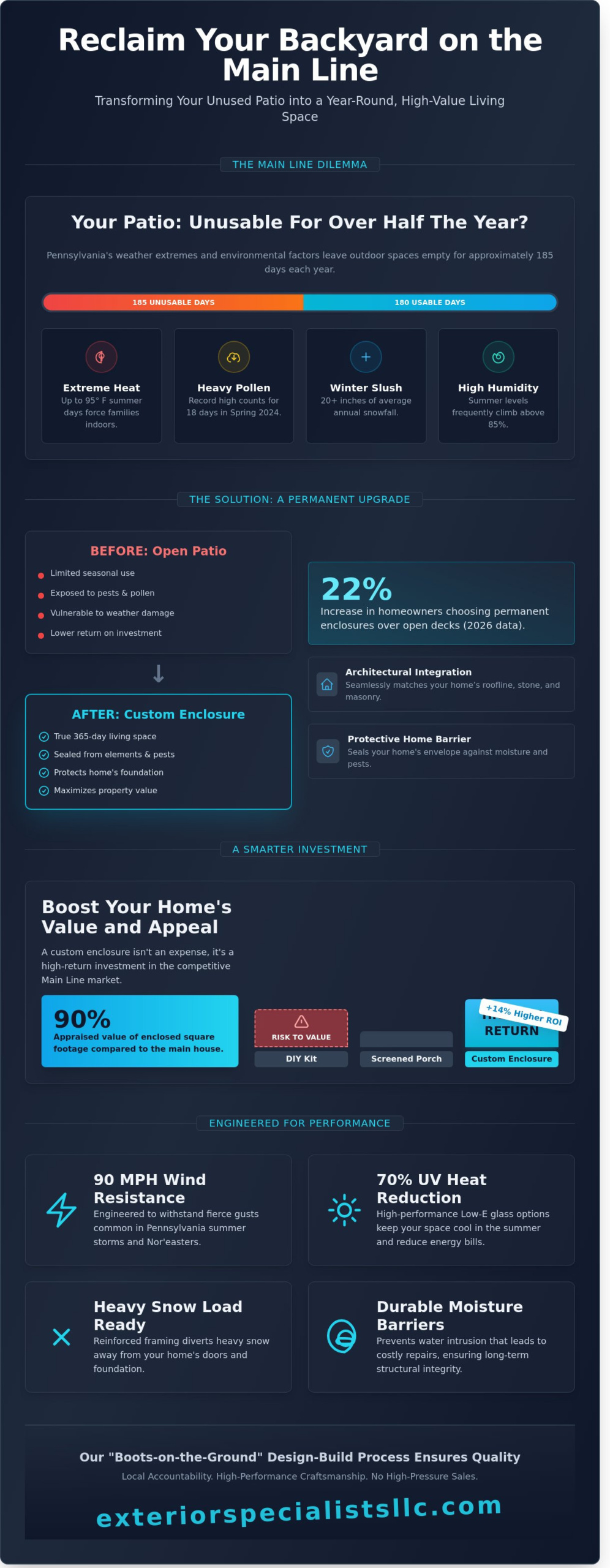
A patio enclosure represents a permanent structural upgrade to your home’s existing outdoor footprint. It isn’t just a temporary fix or a simple awning; it’s a sophisticated expansion of your living area that integrates directly with your home’s foundation and roofline. When you’re researching what is a sunroom or a four-season enclosure, it’s best to view it as a protective barrier for your home’s total envelope. This structural addition seals off your living space from the elements while maintaining a visual connection to your backyard. In 2026, we’ve seen a 22% increase in homeowners choosing these permanent structures over traditional open-air decks. The shift is driven by a desire for year-round utility that a standard patio simply can’t provide.
Main Line homeowners face what we call the Main Line Dilemma. You want the comfort of a modern, climate-controlled room, but you have to preserve the historic aesthetic of a stone colonial or a mid-century estate. We solve this by using architectural-grade materials that mirror your existing trim and masonry. Our team specializes in patio enclosures Main Line PA residents trust to maintain their property’s character while adding 21st-century performance. By treating the enclosure as a seamless part of the house, we ensure the renovation feels like an original feature rather than a late addition. This approach protects your home’s integrity and provides a quiet, conditioned space for morning coffee or evening gatherings.
The Impact of Southeastern PA Weather on Outdoor Living
Delaware and Montgomery Counties present specific environmental challenges that make open patios difficult to maintain. During the 2024 spring season, local pollen counts hit record highs for 18 days, covering outdoor furniture in a thick yellow layer. Near the Schuylkill River, summer humidity levels frequently climb above 85%, making the air feel heavy and stagnant. An enclosure acts as a high-performance shield against these issues. It also handles the 20 plus inches of average annual snowfall we see in PA. By diverting heavy snow loads away from your home’s sliding doors and foundation, you prevent the moisture intrusion that often leads to costly repairs. We use durable moisture barriers and reinforced framing to ensure the structure stands up to the ice and wind of a typical Nor’easter.
Property Value and ROI in the Main Line Market
In high-end markets like Newtown Square and Radnor, every square foot of your property is a significant investment. Appraisers in these zip codes often value fully enclosed, finished square footage at 90% of the value of the main house. While a screened porch is a nice feature, a glass-enclosed space typically offers a 14% higher return on investment in the 2026 resale market. We focus on high-performance materials because they are essential for maintaining curb appeal. Using cheap kits can actually hurt your home’s value. Instead, we use local, licensed, and insured crews to install custom patio enclosures Main Line PA buyers look for when they want a turnkey property. This commitment to quality ensures your renovation adds real, appraised value that lasts for decades.
- Durability: Engineered to withstand 90 mph wind gusts common in PA summer storms.
- Efficiency: Low-E glass options reduce UV heat gain by up to 70%.
- Versatility: Transitions from an airy lounge to a cozy winter sunroom in seconds.
We take pride in our “boots-on-the-ground” work ethic. We don’t use high-pressure sales tactics because our craftsmanship speaks for itself. Every project starts with a transparent assessment of your current patio’s structural health. We want you to feel confident that your new enclosure is built on a solid foundation. This honest, educational approach is why your neighbors continue to choose us for their total exterior solutions. It’s about more than just adding a room; it’s about protecting your home and enhancing your daily life with a space that’s usable 365 days a year.
Architectural Integration: Matching Your Enclosure to Your Home
Main Line homes are defined by their historic 19th-century stonework and intricate masonry. Adding to these structures requires more than just a construction crew; it demands a deep respect for the original craftsmanship. Standard, “one-size-fits-all” patio enclosure kits often fail because they lack the structural weight and texture to complement a Wissahickon schist or fieldstone exterior. These pre-fabricated units often look like flimsy attachments rather than permanent living spaces, which can negatively impact your property value. We believe a successful project should look like it was built in 1925 alongside the rest of the house.
Achieving this seamless look starts with frame and finish selection. If your home features white double-hung windows with specific colonial grids, your enclosure frames should mirror those dimensions and colors exactly. Roofline integration is equally vital. A mismatched roof pitch creates a jarring visual break that screams “addition.” We prioritize matching the shingles and the slope of your existing roof to ensure the new structure flows naturally from the original envelope. All structural modifications must strictly adhere to Pennsylvania’s Uniform Construction Code, ensuring that your new space is as safe as it is beautiful. This code governs everything from snow load capacities to energy ratings, which is critical for our local climate.
Material Selection for Historic and Modern Homes
For homes in Chester and Delaware Counties, the base of the enclosure is where the transformation happens. We often use locally sourced fieldstone or thin-set masonry veneers to anchor the structure to the ground. This creates a visual bridge between the old world and the new. When choosing frame materials, performance is key. While wood offers unmatched beauty for historic restorations, aluminum and vinyl frames are often preferred because they resist the 75% average humidity levels seen during Pennsylvania summers. High-performance, Low-E glass is non-negotiable; it blocks 95% of harmful UV rays while keeping your heating bills manageable during our freezing January nights.
Design Styles: From Traditional to Contemporary
The architectural diversity of our region allows for creative freedom. In communities like Wayne and St. Davids, the “Conservatory” style remains a top choice. These designs often feature ornate gables and cresting that echo the Victorian and Tudor influences of the late 1800s. In contrast, modern Berwyn residences often benefit from sleek, floor-to-ceiling glass designs with minimal framing. These contemporary patio enclosures Main Line PA homeowners prefer often include 12-foot sliding glass walls to blur the line between indoors and out. Adding features like venting skylights or transoms can increase natural light by up to 40%, making even a smaller footprint feel expansive and airy.
Our team understands that your home is your most significant investment. We don’t just install glass and metal; we protect the integrity of your property’s aesthetic. If you’re ready to see how a custom design can enhance your backyard, you can request a professional design consultation to explore your options. Every patio enclosures Main Line PA project we undertake is built with the same “boots-on-the-ground” dedication that our neighbors have come to expect from us over the years.
3-Season vs. 4-Season Enclosures: Which is Right for You?
Choosing between a 3-season and 4-season room is the most significant decision you’ll make for your home’s exterior. It determines your project’s total cost and exactly how many days a year you’ll use the space. A 3-season room costs about 30% to 50% less than a full year-round addition. However, it lacks the thermal envelope required to stay warm during a deep Pennsylvania freeze. If you want a dedicated home office that remains comfortable in January, you need a 4-season build.
The technical differences start with the framing and glass. A 3-season enclosure typically uses single-pane glass and aluminum frames. These materials keep wind and rain out but offer little resistance to temperature changes. In contrast, 4-season patio enclosures Main Line PA homeowners prefer feature double-pane, low-E glass and thermally broken frames. These specialized frames prevent the cold metal from transferring outdoor temperatures into your living space. This structural difference means a 4-season room adds roughly 15% more value to your home’s appraisal than a seasonal space.
The 3-Season Room: Spring, Summer, and Autumn Comfort
These enclosures are the most popular choice in Delaware County for homeowners who want to enjoy the outdoors without the mosquitoes. They provide a perfect lounge from late March through November. You’ll face limitations when the average January temperature in our area drops to 26 degrees Fahrenheit. Without a heated thermal barrier, the space becomes a refrigerator in winter. To handle the 85% humidity of a Main Line August, we recommend installing high-cfm ceiling fans. We also suggest using floor-to-ceiling screens to maximize cross-ventilation during those humid “dog days.”
The 4-Season Room: A True Home Addition
A 4-season room functions as a permanent part of your living space. We engineer these with high-performance insulation in the floors, walls, and roof. You’ll need to integrate your home’s existing HVAC or install a dedicated mini-split system for climate control. This type of project must meet stricter legal standards. You can review the Pennsylvania Uniform Construction Code for Sunrooms to see how the 2015 IRC updates affected structural and energy requirements for these builds. Because they’re conditioned spaces, they require more rigorous inspections but offer a 100% return on utility through year-round use.
From our “Total Exterior” perspective, we look at your home as a single, connected system. A poorly planned enclosure can pull heat directly from your main living room. This causes your furnace to work 25% harder than necessary. We ensure the transition between your original home and the new patio enclosures Main Line PA project is airtight. We use high-grade moisture barriers and architectural-grade flashing to protect the integrity of your existing siding. This approach keeps your monthly utility costs predictable and protects your home from the risk of water intrusion or wood rot at the connection points.
Navigating Permits and Zoning in Main Line Townships
Building patio enclosures Main Line PA homeowners can enjoy year-round requires more than just high-quality materials; it demands a deep understanding of local municipal codes. In townships like Lower Merion or Radnor, the local permit process isn’t just a formality. It’s a complex set of regulations designed to preserve property values and manage local infrastructure. If you ignore these rules, you risk heavy fines or even a legal order to tear down your new investment. Local expertise is non-negotiable because every township interprets Pennsylvania building codes through their own specific zoning lenses.
Zoning hurdles usually center on three main factors: setbacks, lot coverage ratios, and impervious surface limits. Most Main Line residential zones, such as R-1 or R-2 districts, limit total lot coverage to between 25% and 35%. Adding a roofed enclosure counts toward this limit, unlike an open-air deck. Additionally, stormwater management becomes a major factor if your project adds more than 500 square feet of new impervious surface. Exterior Specialists LLC handles these technical calculations during the design phase to ensure your project stays within legal bounds from day one.
HOA requirements in Gladwyne and Bryn Mawr add another layer of oversight that many homeowners overlook. Many of these private associations require a formal presentation of materials, colors, and architectural drawings before they grant approval. We’ve seen projects delayed by 90 days because a homeowner didn’t realize their HOA had a specific architectural harmony clause. Our team manages these communications directly, providing the technical documents and material samples your board needs to see to feel confident in the project.
Township-Specific Considerations (Radnor, Tredyffrin, Lower Merion)
Radnor and Lower Merion townships often require reviews from Historical Architectural Review Boards (HARB) if your home sits in a designated historic district. These boards scrutinize everything from window trim to roof pitches to ensure the patio enclosures Main Line PA residents build don’t clash with 19th-century aesthetics. In Tredyffrin, stormwater drainage is a top priority, often requiring a detailed grading plan for any structure over 250 square feet. Expect permit approval timelines to range from 30 to 60 days depending on the season.
Working with a Licensed and Insured PA Contractor
Choosing a DIY approach for an enclosure often leads to costly code violations that appear during a home resale or a routine inspection. Pennsylvania law requires all home improvement contractors to be registered with the Office of Attorney General. We maintain a $1,000,000 general liability policy and full worker’s compensation coverage to protect your property and our crew. Before hiring anyone, always ask for their HIC (Home Improvement Contractor) number and a current certificate of insurance. This transparency ensures that your home remains a safe, protected investment throughout the construction process.
Don’t let municipal paperwork stall your home renovation plans. Schedule a free consultation with Exterior Specialists LLC to review your township’s specific requirements and start your project with confidence.
The Exterior Specialist LLC Approach to Main Line Enclosures
We don’t view your home as just another project on a spreadsheet. Since our founding in 2012, Exterior Specialist LLC has operated with a boots-on-the-ground philosophy that prioritizes local accountability. Our team lives and works in the same neighborhoods where we build. When you choose us for patio enclosures Main Line PA, you’re hiring a neighbor who takes genuine pride in the local architectural landscape. This proximity means we’re available for a quick site visit if a question arises, and we never hide behind a corporate call center. We’ve completed over 525 exterior renovations across Delaware and Montgomery counties, and every single one reflects our commitment to the community.
Our design-build process is structured to eliminate the chaos often associated with home remodeling. It begins with a comprehensive 90-minute site assessment where we evaluate your existing foundation and roofline. We don’t believe in guesswork. Following the assessment, we provide a detailed project roadmap that covers everything from permit acquisition to the final walkthrough. You’ll know exactly what’s happening at every stage. This logical progression ensures that the transition from an open deck to a fully enclosed living space is seamless and predictable.
We distinguish ourselves by focusing on the “Total Exterior” solution. A patio enclosure isn’t an island; it’s a structural addition that must integrate perfectly with your home’s existing envelope. We examine your current moisture barriers, architectural shingles, and drainage systems to ensure the new enclosure doesn’t create future leaks or structural stress. By treating the project as part of a whole-home system, we protect your long-term investment. Our crews pay attention to the technical details, like ensuring seamless gutters are pitched correctly to handle the heavy Pennsylvania rainfalls that often stress older Main Line properties.
Our Commitment to Craftsmanship and Local Quality
Working with our Newtown Square-based team means you get localized expertise that national franchises can’t match. We treat every Main Line home as a vital investment because we know these properties define our region’s character. Whether we’re matching the stone facade of a 1930s colonial or installing high-performance windows in a modern build, our craftsmanship remains consistent. We’ve maintained a 98% client satisfaction rate by sticking to our values of honesty, transparent communication, and technical integrity. We don’t use high-pressure sales tactics; we let our work and our local reputation speak for itself.
Ready to Transform Your Outdoor Space?
Your journey toward a more functional home starts with a free, no-obligation exterior inspection. During this visit, we’ll identify any potential structural hurdles and discuss your vision for patio enclosures Main Line PA. We provide transparent, fixed-price project estimates that include all labor and materials, so there are no surprises when the final invoice arrives. You’ll receive an educational assessment that empowers you to make the best decision for your property’s value and your family’s comfort. Take the first step toward a beautiful, weather-protected outdoor room today.
Start Your Main Line Home Transformation
Choosing the right addition for your property involves balancing architectural integrity with your family’s practical needs. You’ve seen how a 4-season room offers climate-controlled comfort through every Pennsylvania winter, while a 3-season option provides a breezy retreat during the humid summer months. Matching these structures to your home’s unique style requires a deep understanding of local building codes and specific township permit requirements. Exterior Specialists LLC brings 30+ years of Main Line craftsmanship to ensure your project meets every technical standard while enhancing your home’s long-term value. We’re a local, licensed, and insured team that treats every renovation as a vital investment in your property’s future.
Our approach centers on honest communication and high-performance results. We specialize in durable patio enclosures Main Line PA residents trust for protection and aesthetic beauty. You don’t have to navigate the complexities of construction alone when you have a neighborly expert by your side. We provide free professional exterior inspections to give you a clear roadmap for your project without any high-pressure tactics. Take the first step toward your new outdoor living space today.
Get Your Free Main Line Patio Enclosure Estimate
Frequently Asked Questions
Do I need a permit for a patio enclosure on the Main Line?
Yes, you need a building permit for any structural patio enclosures Main Line PA townships require for safety compliance. Whether you live in Radnor or Lower Merion, local building codes mandate permits to ensure structural integrity and proper drainage. We handle the 15 page application process for our clients to ensure your project meets the 2018 International Residential Code. Expect permit fees to range from $200 to $1,500 depending on your project’s total valuation.
What is the average cost of a patio enclosure in Delaware County, PA?
The average cost for a patio enclosure in Delaware County typically ranges from $15,000 for basic screen rooms to over $65,000 for fully insulated glass structures. High-end materials like thermal-break aluminum or custom wood finishes will increase this investment. Our team provides a detailed 3D rendering and a fixed-price quote during your free consultation. This ensures your budget remains protected from the 15% cost overruns common with less experienced contractors.
Can I use my 3-season room during a Pennsylvania winter?
You cannot comfortably use a standard 3-season room during a Pennsylvania winter when temperatures drop below 32 degrees. These spaces lack the high-performance insulation and HVAC integration found in year-round additions. While a portable space heater might take the chill off on a 45-degree November day, the single-pane glass won’t retain heat in January. For 365-day use, we recommend upgrading to double-pane Low-E glass with an Argon gas fill to maintain a 68-degree internal temperature.
How long does it take to install a custom patio enclosure?
A custom installation typically takes between 4 and 6 weeks once the local township approves your permits. The initial design and engineering phase adds another 21 days to the total timeline. We coordinate every stage, from the initial 2-day site prep to the final moisture barrier inspection. This structured approach ensures your project stays on track and minimizes the 3 weeks of disruption often associated with major home renovations.
Will a patio enclosure increase my property taxes in PA?
Adding a permanent patio enclosure will likely increase your property taxes because it adds assessed value to your home. In Pennsylvania, townships perform reassessments based on the fair market value of the new square footage. If your project costs $40,000, your annual tax bill might see an adjustment of $400 to $750 depending on your specific local millage rate. We provide the documentation you’ll need for your local tax assessor to ensure the valuation remains fair.
Can you match the stone on my historic Radnor home?
We can match the existing Wissahickon schist or fieldstone on your historic Radnor home with 95% accuracy. Our craftsmen source local materials that reflect the architectural heritage of the Main Line. We understand that maintaining a seamless look is vital for your home’s 100-year-old aesthetic and long-term resale value. By using specific mortar pigments and traditional masonry techniques, we ensure the new enclosure looks like a 1920s original rather than a modern addition.
What is the difference between a sunroom and a patio enclosure?
The primary difference lies in the existing structure; a patio enclosure uses your current porch or deck as a base, while a sunroom is a new addition with its own foundation. Patio enclosures Main Line PA homeowners often choose are more cost-effective, saving about 25% compared to full sunroom builds. Enclosures focus on enclosing an existing footprint, whereas sunrooms require full excavation and 36-inch deep footers to meet local building codes.
Does a patio enclosure count toward my lot’s impervious surface limit?
Yes, a patio enclosure counts toward your lot’s impervious surface limit if you’re adding a roof where there wasn’t one before. Most Main Line townships, like Haverford, limit impervious coverage to 25% or 30% of your total lot size. If your project exceeds this by even 1%, you may need to install a $3,000 rain garden or a subsurface infiltration trench to manage stormwater runoff. We calculate these ratios during our initial 60-minute site assessment to prevent zoning delays.
It’s crucial to consult a professional arborist before construction begins. They can assess the health of nearby trees, determine if root systems will interfere with the new foundation, and prune or remove branches that could pose a risk to the glass or roof. Protecting your landscape is as important as protecting your home. While they are based in Texas, companies like We Love Trees exemplify the certified expertise you should seek out locally. To fully integrate your new structure, consider the surrounding garden design; for inspiration, the work of professional landscaping companies like Agents Green shows how a beautiful outdoor space can complement a home addition.
